


Vibration Reduced by up to 94% Through In-Situ Dynamic Balancing
Date: April 2026
Engineer: N. Sasi Vardhan Reddy, Assistant Manager, Level -4 Vibration Analyst
Equipment: Auxiliary boiler forced draft (FD) fans — overhung configuration, 1760 RPM, 90 kW
Location: Abu Dhabi, UAE
Summary
Two auxiliary boilers forced draft fans aboard a Logistics vessel in Abu Dhabi had been experiencing dangerously elevated vibration levels since commissioning that triggered repeated motor bearing failures, fractured mounting bolts, and cracking of the fan impeller casings. Technomax condition monitoring engineers identified residual unbalance in both fan impellers as the root cause. Following in-situ dynamic balancing, overall vibration levels were reduced by up to 94% — from a peak of 101.65 mm/s to 6.0 mm/s — restoring both fans to stable, safe operation without shutdown of the vessel.
The Problem: Persistent High Vibration Since Commissioning
| FD Fan 1 | FD Fan 2 | |
| Peak overall vibration before balancing | 86.01 mm/s | 101.65 mm/s |
| Peak 1X vibration before balancing | 81.76 mm/s | 81.76 mm/s |
| Consequences | Bearing damage, bolt fracture, casing cracks | Bearing damage, abnormal sound, unsafe to measure DE bearing |
The operations team had been dealing with recurring mechanical failures since the fans were first commissioned. The symptoms were consistent and worsening: motor bearing damage requiring repeated replacement, mounting bolts loosening and fracturing under dynamic load, and visible cracking propagating through the fan impeller casings. The vessel operations team contacted Technomax to identify the root cause and carry out rectification.
Equipment Specifications
The auxiliary boiler FD fans are overhung-type centrifugal fans — a configuration in which the impeller is mounted directly onto the induction motor shaft with no dedicated fan bearings. This arrangement places the full dynamic load of the impeller directly onto the motor bearings, making these machines exceptionally sensitive to any residual unbalance in the impeller.
| Parameter | Value |
| Fan model | FD-116-2 (Forced Draft Fan) |
| Configuration | Overhung — impeller direct-mounted on motor shaft |
| Operating speed | 1760 RPM |
| Motor power | 90 kW |
| Bearing numbers | 6218 / 6313 ZZ |
| Rated current | 140 A |
| Air volume | 530 m³/min |
| Static pressure | 5,700 Pa |
| Total weight | Approximately 1,600 kg |
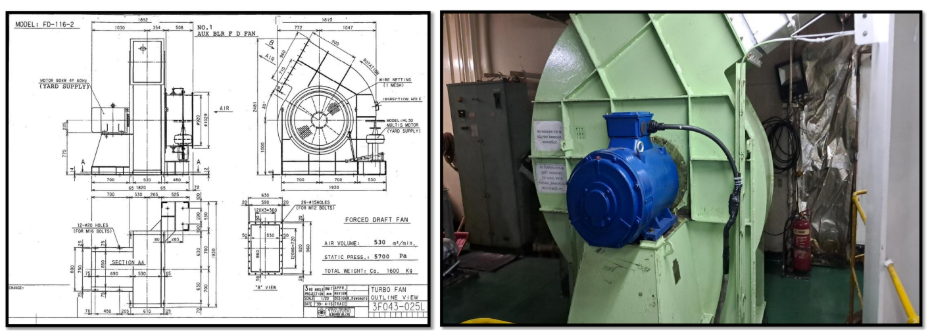
The damper control system mounted beneath the machine frame regulates combustion airflow for efficient fuel burning, stable furnace pressure, and reliable steam generation during vessel operations. Both fans are critical to vessel propulsion and boiler safety — unplanned failure carries significant operational and safety consequences.
Diagnosis: How Technomax Identified Residual Unbalance
Step 1 — Vibration Survey
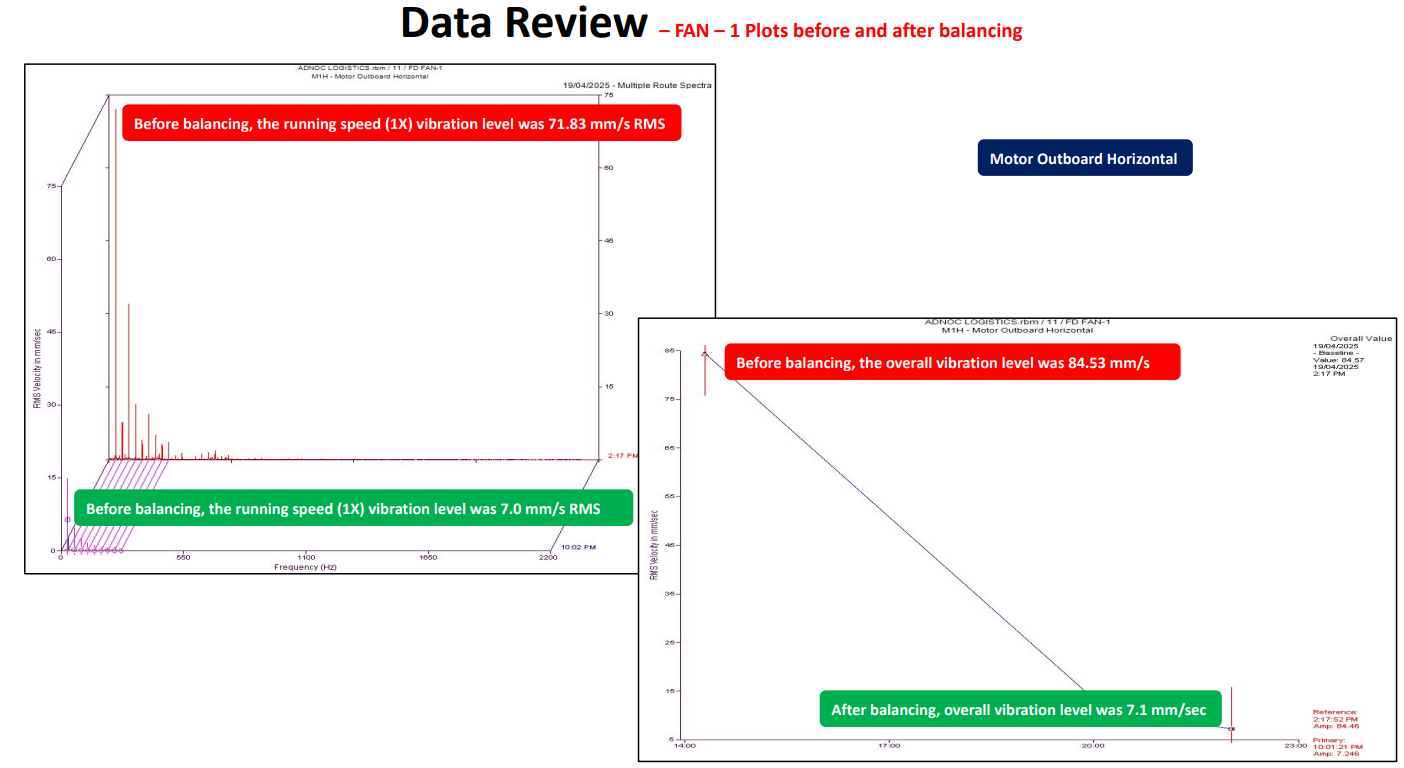
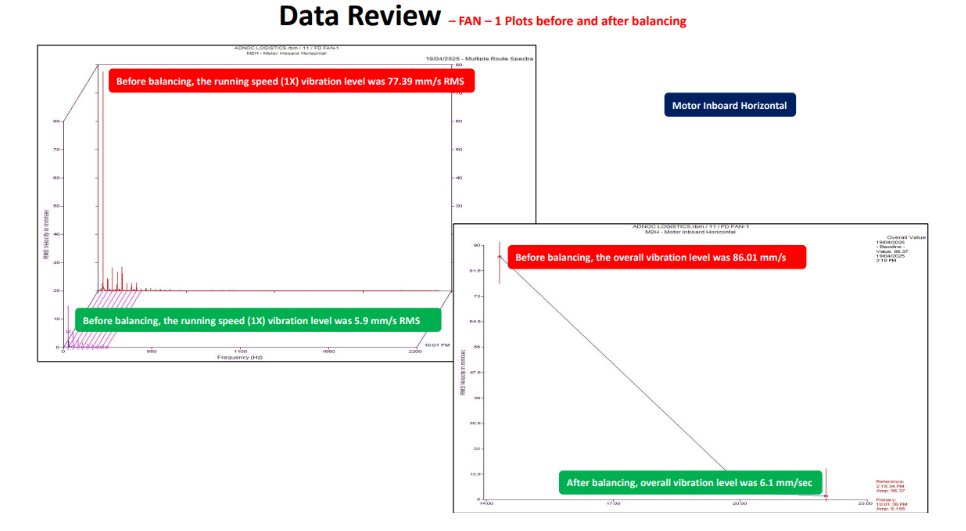
Upon arriving onboard, Technomax engineers conducted a full vibration survey across both fans, collecting overall vibration velocity (mm/s RMS) and frequency spectra at all accessible bearing locations — Motor NDE (Non-Drive End) and Motor DE (Drive End) in horizontal, vertical, and axial directions.
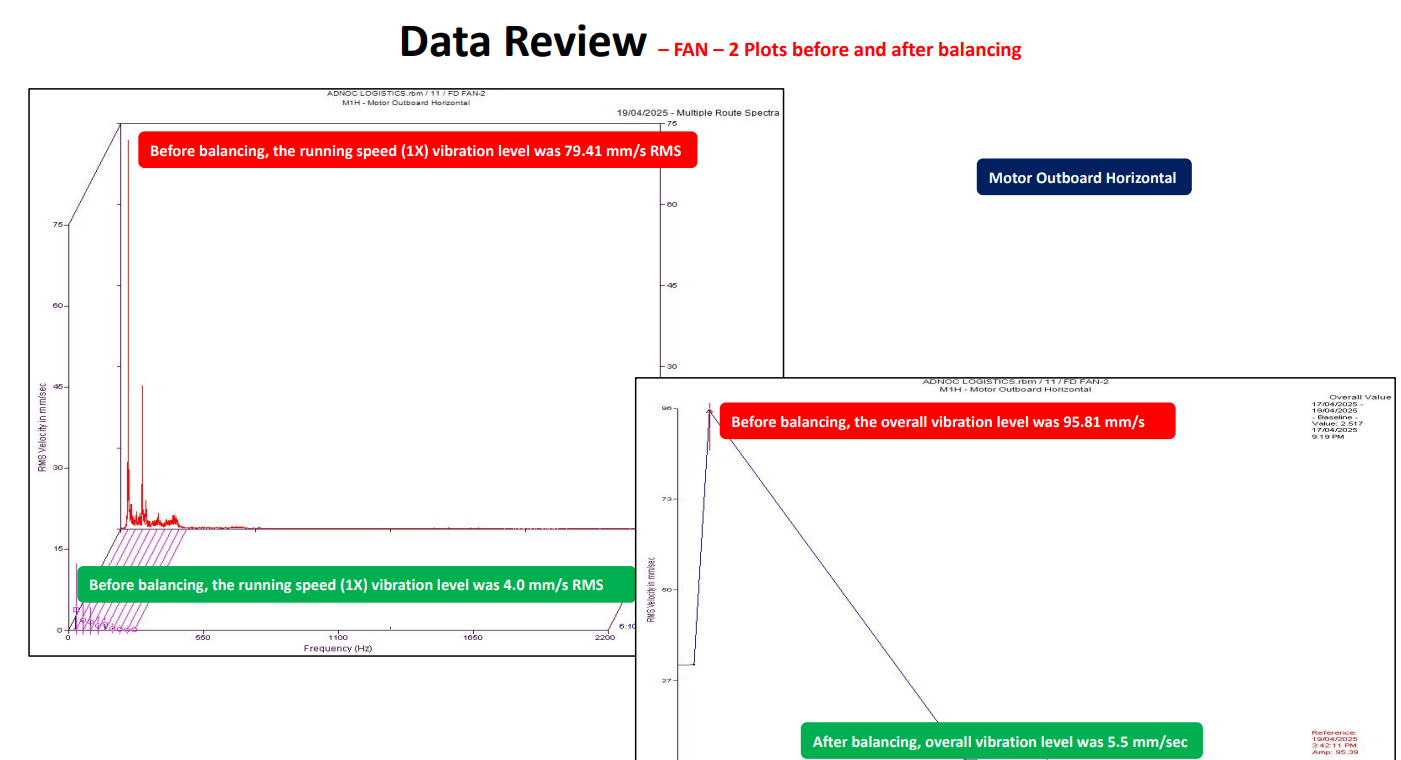
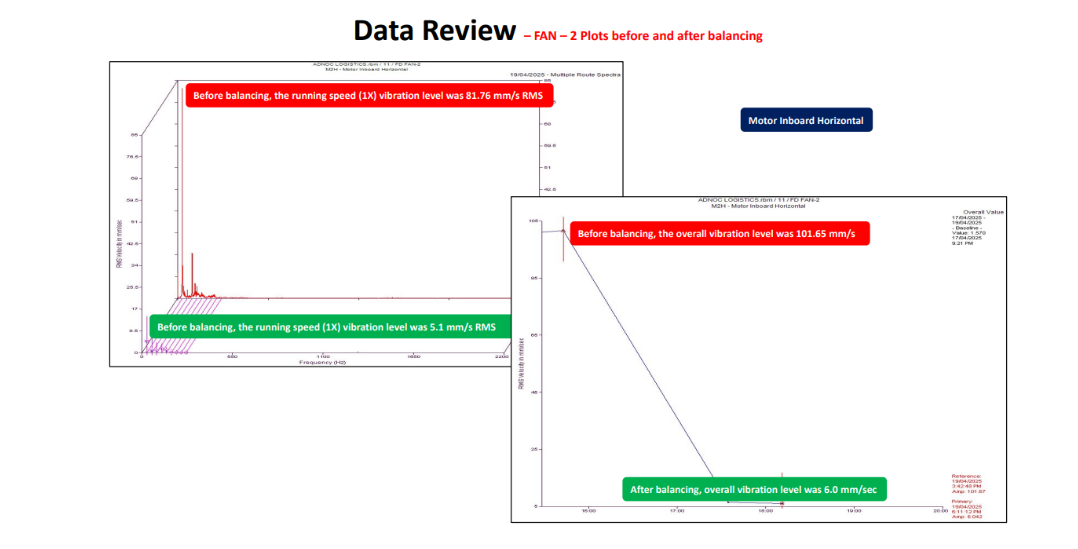
The vibration spectrum on both fans immediately showed a dominant 1X synchronous peak — a vibration component occurring at exactly the running speed frequency (1760 RPM / 29.3 Hz). A strong, dominant 1X peak is the classical spectral signature of rotor imbalance.
Step 2 — Phase Analysis Confirmation
To confirm that the main issue was imbalance rather than misalignment, looseness, or resonance, Technomax engineers measured the absolute phase data using a tachometer and a phase reference. Phase analysis revealed the consistent single-plane phase relationship between the measurement points that is characteristic of residual unbalance in an overhung rotor.
The combination of the dominant 1X spectral peak and the phase data confirmed residual unbalance in the fan impellers as the root cause of the high vibration in both fans.
What is residual unbalance?
Residual unbalance occurs when the mass distribution of a rotating component is not perfectly centred on the rotational axis, in this case, the fan impeller. Even small mass eccentricities generate centrifugal forces proportional to the square of rotational speed. At 1760 RPM, even a few hundred grams of imbalance can generate forces of several kilonewtons, sufficient to damage bearings, fracture mounting hardware, and crack structural components over time.
Why It Was Severe in This Configuration
The overhung mounting arrangement made the unbalance effect significantly worse than it would be in a bearing-supported fan. With the impeller cantilevered directly on the motor shaft, the dynamic force from imbalance is applied as a bending moment on the motor shaft — magnifying bearing loads at both the NDE and DE bearings simultaneously. This explains why both bearings were failing repeatedly despite individual replacements.
The Solution: In-Situ Dynamic Balancing
Technomax engineers carried out in-situ single-plane dynamic balancing on both fan impellers aboard the vessel, without dismounting the impellers or removing the fans from service longer than necessary.
Balancing Procedure
- Initial vibration and phase measurements taken at motor NDE and DE bearing locations
- Trial weight runs performed to determine the influence coefficient of the impeller
- Correction weight mass and angular position calculated using the influence coefficient method
- Correction weights welded to the impeller at the calculated positions
- Post-balancing vibration measurements taken to confirm acceptance
Note: Balancing was performed with the fan impeller suction casing temporarily removed to allow direct access to the impeller for welding of balancing weights. A slightly elevated 1X amplitude is expected in the final post-installation readings due to the aerodynamic influence of the reinstalled casing — this is normal and within acceptable limits.
Correction Weights Applied
FD Fan 1:
- Total correction weight: 198 grams
- 180 grams at the light-weight location (static correction)
- 18 grams at 112° from the reference point (dynamic trim)
FD Fan 2:
- Total correction weight: 216 grams
- 162 grams at 180° from the reference point
- 54 grams at 30° from the reference point
Results: Before and After Balancing
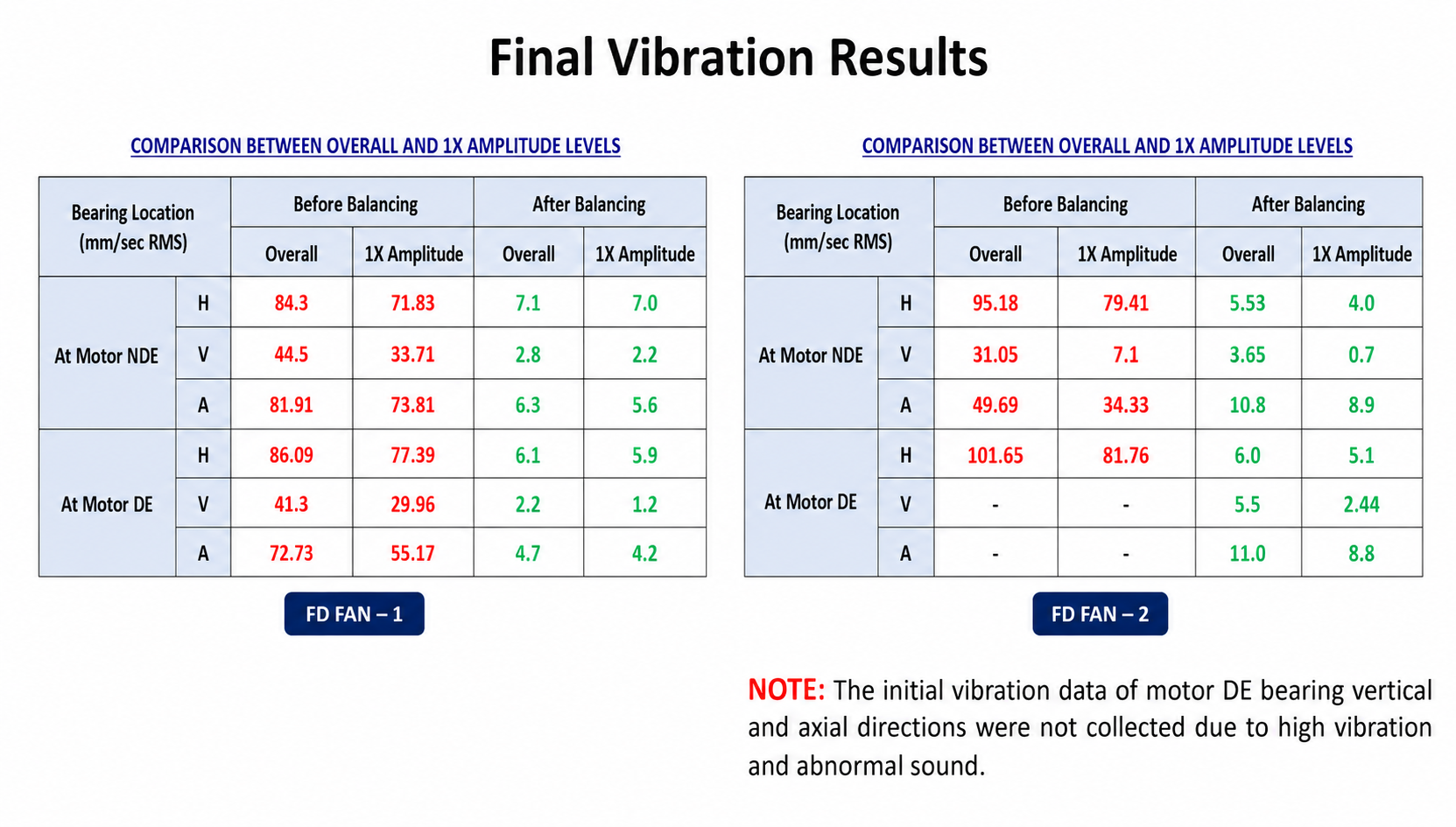
FD Fan 1 — Final Vibration Measurements
| Bearing Location | Direction | Overall Before (mm/s) | 1X Before (mm/s) | Overall After (mm/s) | 1X After (mm/s) | Reduction |
| Motor NDE | Horizontal | 84.30 | 71.83 | 7.1 | 7.0 | 92% |
| Motor NDE | Vertical | 44.50 | 33.71 | 2.8 | 2.2 | 94% |
| Motor NDE | Axial | 81.91 | 73.81 | 6.3 | 5.6 | 92% |
| Motor DE | Horizontal | 86.09 | 77.39 | 6.1 | 5.9 | 93% |
| Motor DE | Vertical | 41.30 | 29.96 | 2.2 | 1.2 | 95% |
| Motor DE | Axial | 72.73 | 55.17 | 4.7 | 4.2 | 94% |
FD Fan 2 — Final Vibration Measurements
| Bearing Location | Direction | Overall Before (mm/s) | 1X Before (mm/s) | Overall After (mm/s) | 1X After (mm/s) | Reduction |
| Motor NDE | Horizontal | 95.18 | 79.41 | 5.53 | 4.0 | 94% |
| Motor NDE | Vertical | 31.05 | 7.10 | 3.65 | 0.7 | 88% |
| Motor NDE | Axial | 49.69 | 34.33 | 10.8 | 8.9 | 78% |
| Motor DE | Horizontal | 101.65 | 81.76 | 6.0 | 5.1 | 94% |
| Motor DE | Vertical | — | — | 5.5 | 2.44 | — |
| Motor DE | Axial | — | — | 11.0 | 8.8 | — |
DE bearing vertical and axial data were not collected before balancing due to dangerously high vibration levels and abnormal mechanical sound. Initial measurements were limited to safe accessible locations.
At a Glance
| FD Fan 1 | FD Fan 2 | |
| Peak overall vibration — before | 86.09 mm/s | 101.65 mm/s |
| Peak overall vibration — after | 7.1 mm/s | 6.0 mm/s |
| Vibration reduction | 92% | 94% |
| Correction weight added | 198 g | 216 g |
| Outcome | Stable operation restored | Stable operation restored |
Conclusions
Residual unbalance in the fan impellers was confirmed as the sole root cause of the elevated vibration, repeated bearing failures, bolt fractures, and impeller casing cracks experienced by both FD fans since commissioning.
The unbalance had almost certainly been present from the manufacturing stage — the impellers were not balanced to an adequate grade (ISO 1940 G2.5 or better) before installation. In an overhung configuration operating at 1760 RPM, even modest residual unbalance generates destructive dynamic forces that no bearing or structural fixing can absorb indefinitely.
In-situ dynamic balancing was confirmed as a fully effective corrective measure. Both fans achieved stable, quiet operation within acceptable vibration limits immediately after balancing.
Lessons Learned
- Verify impeller balance grade at procurement stage. All fan impellers should be supplied with a balance certificate stating the residual unbalance in g·mm and the balance grade achieved (ISO 1940). For a 90 kW fan impeller operating at 1760 RPM, ISO 1940 Grade G2.5 is the minimum requirement. Accepting impellers without balance certification is a documented risk for premature failure.
- Overhung fan configurations amplify unbalance effects. In a standard between-bearings fan, unbalance loads are shared between two bearing supports. In an overhung configuration, the full imbalance moment is applied as a cantilever load on a single bearing set — the motor bearings. The same residual unbalance that might cause acceptable vibration in a between-bearings fan can cause catastrophic vibration in an overhung machine.
- Vibration monitoring immediately after commissioning is essential. Had a vibration baseline been established and monitored in the weeks immediately after commissioning, the unbalance would have been identified before it caused bearing damage, bolt fracture, and casing cracks. Early detection would have allowed corrective balancing at significantly lower cost and without the consequential damage.
- In-situ dynamic balancing is effective and efficient. Field balancing of large industrial fan impellers does not require workshop dismantling or expensive rotor removal. Technomax carries out in-situ balancing aboard vessels and at industrial facilities across the UAE, achieving results that meet or exceed ISO 1940 acceptance criteria.
About the Engineer
- Sasi Vardhan Reddy Assistant Manager — Condition Monitoring Services Technomax Middle East Engineering LLC, Abu Dhabi, UAE
- Sasi Vardhan Reddy leads condition monitoring field operations for Technomax across the UAE and GCC. He specialises in vibration analysis, in-situ dynamic balancing, and rotating machinery diagnostics for marine, oil & gas, and industrial clients. This case was presented at a technical session in Abu Dhabi on 24 April 2026.
About Technomax
Technomax Middle East Engineering LLC is an Abu Dhabi-based engineering company providing condition monitoring, predictive maintenance, and machinery diagnostic services to industrial and marine clients across the UAE, Oman, and Saudi Arabia since 2005. Services include vibration analysis, dynamic balancing, infrared thermography, partial discharge testing, lube oil analysis, laser shaft alignment, and remote machinery monitoring.
ISO 9001:2015 · ISO 14001:2015 · ISO 45001:2018 certified
Frequently Asked Questions
- What is residual unbalance in a fan impeller?
Residual unbalance occurs when the mass of a rotating component — such as a fan impeller — is not perfectly distributed around its rotational axis. The off-centre mass generates a centrifugal force that increases with the square of rotational speed, producing vibration, dynamic bearing loads, and eventually mechanical failure. Residual unbalance is corrected by adding or removing small masses at calculated angular positions on the rotor.
2. What is in-situ dynamic balancing?
In-situ dynamic balancing is the process of correcting rotor unbalance while the rotor remains installed in the machine — without dismantling, removing the rotor to a workshop, or taking the equipment fully out of service for extended periods. Technomax engineers mount vibration sensors and a phase reference tachometer on the machine, run trial weights to determine the imbalance correction required, and weld or bolt correction masses to the rotor at the calculated positions. The method is validated against ISO 1940 acceptance criteria.
3. What does a dominant 1X vibration peak indicate?
A dominant 1X vibration peak in the frequency spectrum — a peak at exactly the rotational speed frequency — is the primary spectral indicator of rotor unbalance. It indicates that the main forcing frequency is synchronised with shaft rotation, which is the defining characteristic of an unbalance force. Phase analysis is used to confirm unbalance and distinguish it from misalignment or resonance, which can also produce elevated 1X components.
4. How quickly can Technomax mobilise for a dynamic balancing job in the UAE? Technomax can typically mobilise for dynamic balancing surveys within 24 to 48 hours anywhere in the UAE, including onboard vessels at anchor or alongside in Abu Dhabi, Dubai, Jebel Ali, and Fujairah ports. Contact us with your equipment details and location for a rapid response.
5. What balance grade should a fan impeller be supplied to?
Fan impellers operating at speeds of 1,000–3,600 RPM in industrial and marine applications should be balanced to ISO 1940 Grade G2.5 as a minimum. High-speed or precision applications may require G1.0. Always request a balance certificate from the impeller supplier stating the residual unbalance in g·mm and the balance grade achieved.




Get Started Now!
It takes less than a minute of your time. Or you may simply call +971 2 555 1 783