


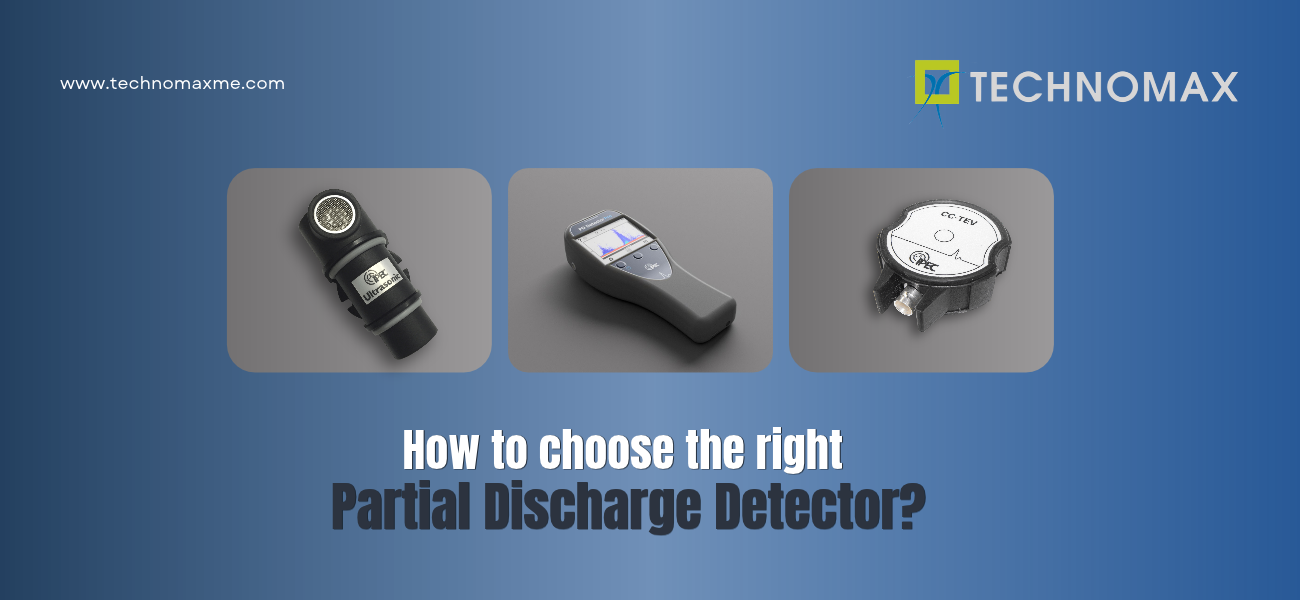
How to choose the right partial discharge detector?
Partial Discharge (PD) is a small electrical discharge that develops in a small area of an insulation system when electrical stress becomes concentrated around a weak point. It can occur without causing a sudden failure, but as it keeps getting repeated, this PD activity can progressively weaken and compromise the integrity of insulation and eventually lead to equipment failure.
PD is generally seen with high-voltage assets such as power cables, switchgear, transformers, motors, and other electrical equipment. Issues like insulation ageing, voids, moisture, contamination, manufacturing defects, and mechanical damage can contribute to PD activity. Detecting and monitoring these discharges offers better visibility in insulation health monitoring, helping maintenance teams to promptly identify developing problems and take action before these faults become costly failures or unplanned outages.
Partial discharge activity can be an early marker of developing insulation problems in high-voltage equipment. If left undetected, the repeated discharge activity may accelerate insulation deterioration and increase the risk of equipment failure, unexpected shutdowns, and safety concerns.
In this blog we will see how partial discharge detection works, how PD testing is carried out, and the role of partial discharge detectors in identifying insulation defects. We’ll also look at the different types of partial discharge like online and offline PD Testing and how they can affect high-voltage equipment.
How Partial Discharge Detectors Work
Partial discharge detectors are specialised devices that identify electrical activity that is usually associated with a weak spot in the insulation typically in high-voltage equipment. Depending on the method, detectors capture electrical pulses, electromagnetic signals, or ultrasonic waves produced by discharge activity. The captured signals are carefully analysed to separate real PD from background noise and any other interference.
By thoroughly examining signal patterns, characteristics, and discharge activity over time, technicians can interpret findings, compare the actual condition of the insulation and identify areas that may need detailed analysis or quick intervention. The nature of PD can vary depending on the type and construction of the asset. Transformers, switchgear, power cables, and rotating electrical machines might exhibit different discharge patterns, including internal, surface, and corona-related activity.
For reliable PD detection, the PD activity detection method and sensor need to be compatible with the equipment and the characteristics of the discharge. IPEC provides a wide range of sensing technologies, including TEV sensors, HFCT clamps, UHF probes, and ultrasonic acoustic sensors, designed for different HV applications. With these advanced sensors and detectors, regular PD testing and continuous monitoring are made hassle-free, helping detect developing faults early, which enables the maintenance team to plan corrective action strategically and reduce the risk of safety hazards.
Choosing the Right PD Sensors for Your Assets
Different HV assets can exhibit different types of partial discharge. The following section highlights common PD types and the ideal sensors suited to detecting them.
1. Transformers
Transformers can experience PD within their insulation systems, with the discharge symptoms varying between oil-filled and dry-type designs. Choosing suitable sensors helps detect developing insulation anomalies and determine equipment condition.
- Oil-Filled Transformers: PD could develop in oil, gas bubbles, or solid insulation around the windings. Internal UHF sensors can detect high-frequency emissions from discharges inside the tank, while HFCT clamps monitor electrical pulses through earth connections. TEV and contact ultrasonic sensors can provide additional information when investigating accessible components and potential discharge sources.
Key Sensors: UHF sensors, HFCT clamps, TEV sensors, and contact ultrasonic probes.
- Dry-Type Transformers: These transformers might experience PD around winding insulation, air gaps, and exposed connections. TEV sensors detect high-frequency signals on grounded enclosures, while ultrasonic sensors help identify discharge activity near windings and terminals. HFCT clamps can also monitor cable earth connections for associated PD signals.
Key Sensors: TEV sensors, ultrasonic probes, and HFCT clamps.
2. Switchgear
Partial Discharge in switchgear can start from insulation defects, surface contamination, or electrical stress around conductors and connections. The appropriate detection method depends on the switchgear design and the location of the suspected defect.
- Air-Insulated Switchgear (AIS): Corona and surface tracking might develop around busbars, insulators, and electrical connections. TEV sensors detect transient signals on metal enclosures, while ultrasonic sensors help locate discharge activity around accessible components. HFCT clamps can monitor cable earth connections for PD signals associated with connected feeders.
Key Sensors: TEV sensors, ultrasonic probes, and HFCT clamps.
- Gas-Insulated Switchgear (GIS): PD can occur within the sealed insulation system, producing high-frequency electromagnetic signals. UHF sensors detect these emissions through suitable sensor ports or insulating interfaces. Noise-gating technology can help distinguish relevant signals from interference originating in neighbouring sections.
Key Sensors: UHF sensors and noise-gating systems.
- Outdoor High-Voltage Switchyards: Corona and surface discharge can occur around insulators and other high-voltage components exposed to outdoor conditions. Parabolic ultrasonic sensors allow engineers to scan equipment from a distance and identify areas that may require closer inspection.
Key Sensors: Parabolic ultrasonic sensors.
-
Cables and Accessories
Underground Cables – Joints and Terminations:
Partial discharge in underground cables is seen generally due to insulation defects at joints, splices, and terminations, including voids and localised insulation damage. These defects generate high-frequency PD pulses that travel through the cable and its grounding system. Normally, HFCT sensors are clamped around the cable screen, earth connection, or neutral conductor at terminations and link boxes to spot these high-frequency current pulses, which allows online monitoring without direct connection to the cable conductor and supports condition monitoring along extended cable sections.
Key sensor: HFCT installed around the cable screen, earth, at terminations or joint vaults.
4. Rotating Machines
Motors and Generators – Stator Windings:
In high-voltage motors and generators, PD starts within stator insulation due to internal voids, contamination, insulation deterioration, or surface discharge around the end windings. IPEC monitoring solutions can use HFCT sensors on the stator neutral or grounding connection to detect PD currents returning through the ground path. High-voltage capacitive couplers (HVCC) can also be installed at phase terminals to quickly pick up PD pulses directly from the high-voltage circuit. Using these sensing methods combined provides broader coverage of insulation-related discharge activity during normal operation.
Key sensors: HFCT on the neutral/ground connection and HV capacitive couplers at phase terminals.
PD Sensor Selection by Asset
The reliability of PD monitoring depends on opting for an efficient sensor that aligns with the discharge characteristics, equipment construction, and available access points. UHF sensors are a good option that suits enclosed metal equipment such as GIS and transformer tanks, while HFCTs are commonly used on cable screens, grounding paths, and rotating-machine neutrals. TEV sensors detect high-frequency transient signals seen on metal enclosures, making them the best choice for switchgear and similar equipment. Ultrasonic sensors can complement electrical asset monitoring by detecting acoustic emissions associated with surface discharge and corona.
For critical assets, combining two or more sensor devices and monitoring methods can improve detection confidence and help separate genuine PD activity from electrical or environmental noise. The best option depends on the asset design, expected defect type, operating conditions, and monitoring objective. Let us look at some details:
PD Sensor and Asset Comparison
| Asset / Application | Typical PD Source | Preferred Sensor | Typical Installation | Main Detection Role |
| Underground cables | Insulation defects, voids, joint or termination faults | HFCT | Cable screen, earth lead or link box | Detects high-frequency PD currents |
| HV motors | Stator insulation defects, internal voids, surface discharge | HFCT + HVCC | Neutral/ground connection and phase terminals | Monitors stator insulation condition |
| HV generators | Stator winding and end-winding discharge | HFCT + HVCC | Neutral/ground path and phase terminals | Detects developing insulation activity |
| GIS | Internal insulation defects and floating particles | UHF | GIS enclosure / dedicated sensor ports | Captures fast UHF discharge signals |
| Transformers | Internal insulation discharge | UHF + HFCT | Tank/sensor port and grounding path | Detects and supports PD localisation |
| Metal-clad switchgear | Surface or internal insulation discharge | TEV + Ultrasonic | Metal enclosure and accessible surfaces | Detects transient and acoustic PD activity |
| Exposed insulators | Surface discharge and corona | Ultrasonic | Near the insulation surface | Identifies acoustic discharge activity |
This asset-based approach acts as a guide for industrial operators to select the best-suited PD sensing method rather than relying on a single sensor technology for every application.
Get Advanced PD Monitoring Solutions in the UAE from Technomax
Improve the monitoring of your high-voltage and electrical assets with advanced partial discharge detection solutions from Technomax. Our PD detection equipment helps identify developing insulation issues and supports condition-based maintenance for critical electrical assets.
Technomax partners with renowned PD technology provider IPEC to deliver reliable partial discharge monitoring and detection solutions to industries relying on electrical assets. Alongside PD testing and monitoring, we provide advanced condition monitoring services and asset health monitoring systems designed to help industries identify developing equipment issues, improve maintenance planning, and support reliable plant operations. With experienced engineers and application-focused solutions, TMX can help you select the right monitoring technology for your critical assets.
Ensure reliable PD monitoring solutions and transform the safety of your critical electrical assets. Contact us now!
FAQs
1. How can partial discharge be detected?
Partial discharge can be detected using specialised methods, for instance: TEV, HFCT, UHF, and ultrasonic sensing. The appropriate method depends on the type of asset, insulation system, and suspected location of the discharge.
2.What is a partial discharge detector?
A partial discharge detector is a specialised device used to identify and analyse the electrical, electromagnetic, or acoustic signals produced by localised discharge activity in high-voltage insulation.
3. What are the different types of partial discharge?
Common forms of PD include internal discharge, surface discharge, and corona discharge. The type and characteristics of PD depend on the insulation condition, equipment design, and location of the defect.
4. What is the IEC standard for partial discharge testing?
IEC 60270 is the primary international standard for measuring partial discharge in electrical insulation systems. It explains measurement principles, test circuits, quantities, and procedures used for PD testing.

Recent Blogs



Get Started Now!
It takes less than a minute of your time. Or you may simply call +971 2 555 1 783