



Effect of Varnish and Carbon Deposits on Bearing Clearances and Fluid-Film Characteristics in Rotating Machinery
How a 10-month multi-startup diagnostic investigation revealed oil varnish as the root cause of persistent compressor vibration in Abu Dhabi
Location
Abu Dhabi, UAE
Industry
Oil & Gas / Power Generation
Equipment
4th-stage centrifugal compressor, 4584 RPM
Diagnostic period
October 2024 – January 2026
Presented
6 March 2026, Abu Dhabi
Prepared By:
V Krishna Varma
Category IV Vibration Analyst
N Sasi Vardhan Reddy
Category IV Vibration Analyst
Executive Summary
A simply supported 4th-stage centrifugal compressor operating at 4,584 rpm and driven by a gas turbine experienced a sudden increase in drive-end (DE) bearing vibration following the February 2025 startup. The vibration increase followed seal-oil line flushing and cleaning performed during the January 2025 shutdown.
Trend, Bode and shaft centerline (SCL) data showed abnormal shaft movement and changes in vibration behavior around the critical speed. The observed behavior suggested possible changes in bearing clearance or restricted movement of the bearing pads, affecting fluid-film damping or stiffness.
A subsequent bearing inspection identified significant oil varnish deposits and carbonized buildup on the rotor, radial and thrust bearings, seals, and bearing pads, with signs of rubbing. The radial and thrust bearings, seals and compressor rotor were replaced. Following the intervention, the compressor operated with acceptable vibration levels.
Case Overview
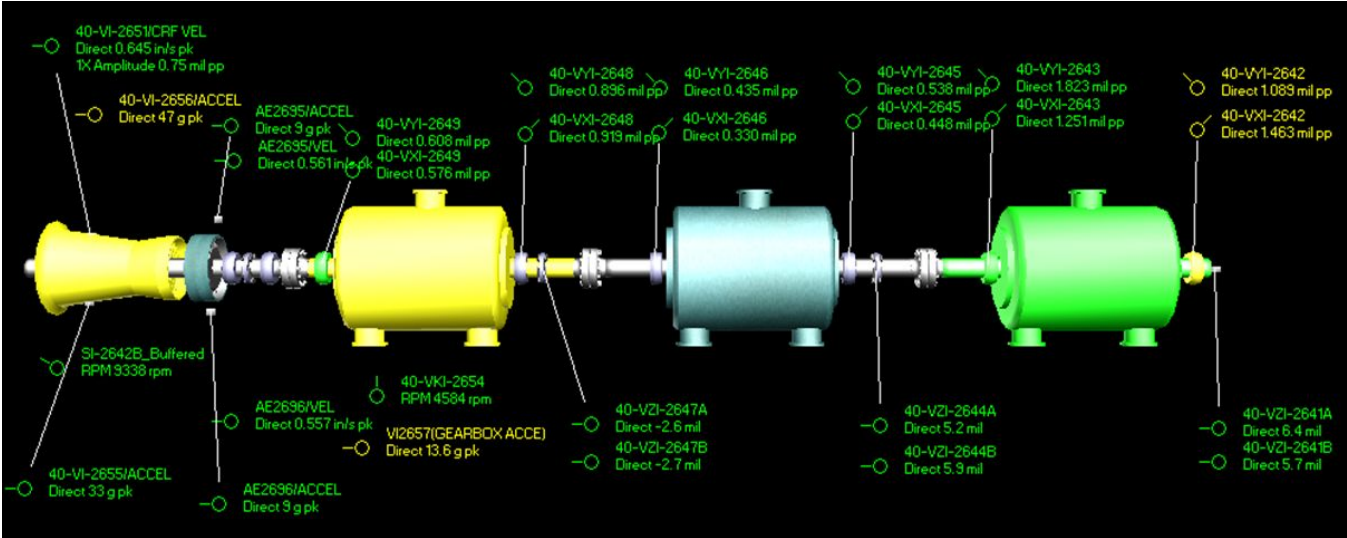
| Equipment | 4th-stage centrifugal compressor |
| Operating speed | 4,584 rpm |
| Drive | Gas turbine at the same speed |
| Monitoring system | Bently Nevada System 1 |
| Bearing monitoring | Proximity probes; six compressor bearings monitored |
| Additional parameters | Lube-oil temperature and process parameters |
| Primary concern | Increased synchronous vibration and abnormal shaft centerline behavior |
| Investigation period | October 2024 to January 2026 |
Problem Statement
- Before the event, compressor bearing vibration remained within acceptable limits, while the power turbine showed high vibration of 47/57 g peak. The power turbine rotor was replaced during the January 2025 shutdown.
- During the January 2025 shutdown, the seal-oil line was flushed and cleaned. Approximately 4,500 liters of oil were discarded, and the degassing tank was replaced.
- After the February 2025 startup, the 4th-stage compressor DE bearing vibration increased to 3.63/2.51 mils peak-to-peak.
- At the 2,658 rpm critical speed, DE bearing vibration increased to approximately 2.0/2.5 mils p-p, compared with approximately 0.7/0.9 mils p-p in December 2024.
- The compressor DE bearing remained in high alarm until 24 July 2025, after which vibration gradually decreased and stabilized at 1.60/1.17 mils p-p.
- Shaft centerline plots showed abnormal movement and different critical-speed behavior during repeated startups.
Condition Monitoring Investigation
Baseline – December 2024
The compressor DE bearing showed 0.7/0.9 mils p-p vibration in the Y/X probes at 2,658 rpm. The SCL plot indicated normal lift of 2.2 mils vertically and 1.1 mils horizontally up to idle speed (3,682 rpm). The NDE bearing showed acceptable vibration, with normal lift of 1.68 mils vertically and 0.17 mils horizontally.
Step Change – February 2025
At the critical speed, the DE bearing vibration increased to approximately 2.0/2.5 mils p-p in the Y/X probes. The SCL plot indicated abnormal lift of 2.1 mils vertically and 2.0 mils horizontally up to idle speed, followed by a slight downward trend and horizontal movement after critical speed. The source material identifies possible changes in bearing clearances or restricted pad movement.
The NDE bearing also showed approximately 1.8/2.2 mils p-p at the critical speed, with abnormal shaft lift and a downward trend after critical speed, possibly associated with changes in bearing clearance.
Startup Trend – May to July 2025
May 2025 Startup — Cross-Over Pattern Emerges
By May 2025, a significant diagnostic shift was visible. The DE bearing vibration had reduced to approximately 2.8 mils vertical and 1.8 mils horizontal at critical speed — a positive trend. However, the NDE bearing had increased substantially to approximately 4.0 mils vertical and 4.9 mils horizontal at critical speed. The SCL at the DE bearing showed an unusual shaft lift of 1.3 mils vertically and 1.7 mils horizontally — the shaft was now moving more in the horizontal direction than vertically, a reversal of the dominant-vertical lift expected from a loaded tilt-pad bearing. The NDE bearing SCL showed abnormal lift of 1.67 mils vertically and 0.9 mils horizontally with a downward trend beyond critical speed.
This cross-over — DE improving while NDE worsens — is consistent with differential deposit behaviour at the two bearing locations: deposits may be dissolving or redistributing at different rates, or the changed oil chemistry after the seal-oil flush is affecting each bearing position differently based on local temperature, oil flow, and clearance.
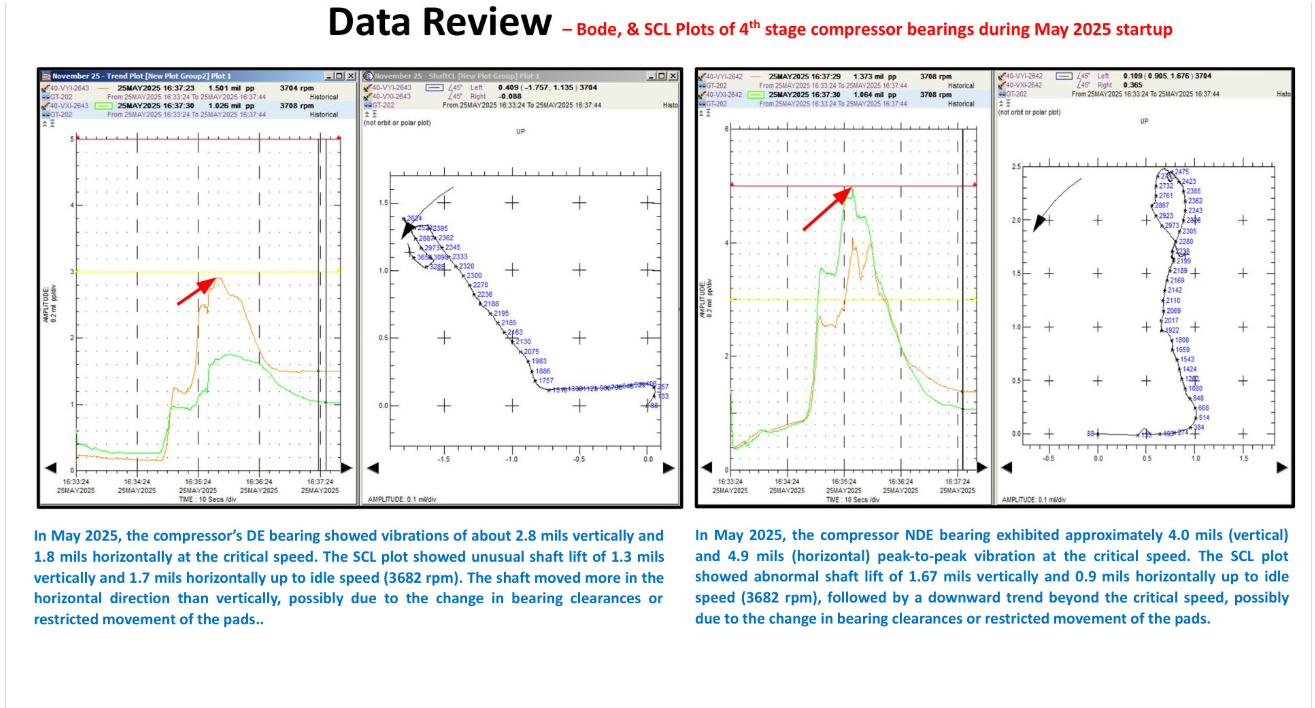
May 2025: cross-over pattern between DE and NDE bearings. DE bearing (left pair): vibration reducing — 2.8 mils vertical, 1.8 mils horizontal at critical speed; SCL lift reversed to horizontal-dominant (1.3V / 1.7H mils). NDE bearing (right pair): vibration significantly increased to 4.0 mils vertical, 4.9 mils horizontal at critical speed; SCL lift 1.67 mils vertical with downward trend beyond critical speed. The opposing behaviour between bearings indicates differential deposit effects at each location.
June 2025 Startup — Pattern Continues
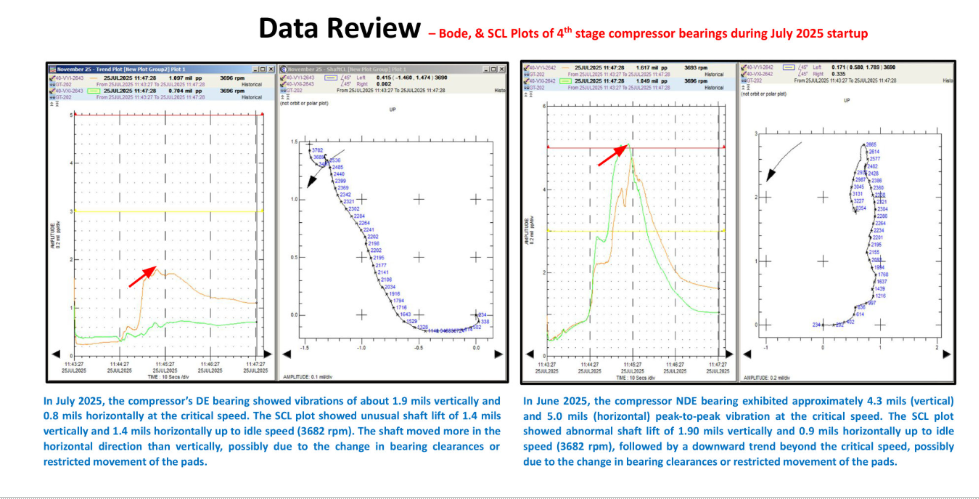
The June 2025 startup confirmed the same trend. The DE bearing continued its gradual improvement — approximately 2.0 mils vertical and 1.0 mils horizontal at critical speed. The NDE bearing remained elevated at approximately 4.3 mils vertical and 5.0 mils horizontal at critical speed. SCL plots at both bearings continued to show abnormal lift, with the NDE bearing showing 1.90 mils vertical and 0.9 mils horizontal lift followed by a downward trend beyond the critical speed.
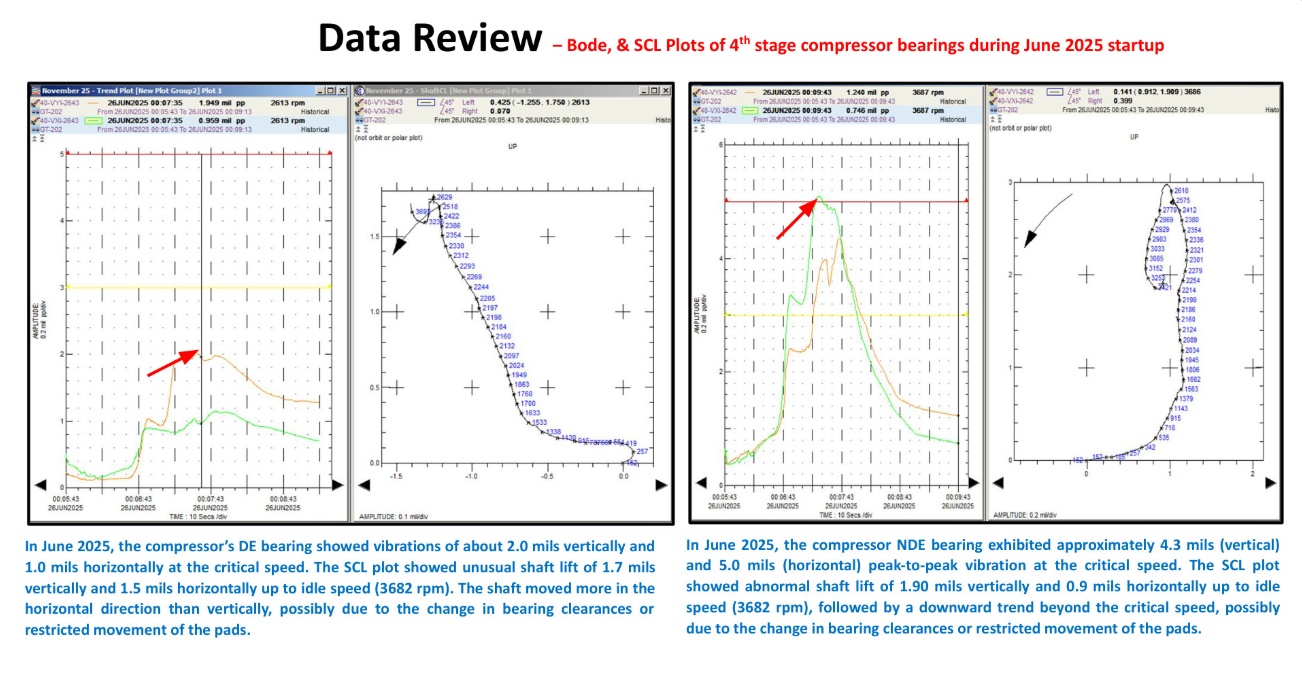
June 2025: cross-over trend continues. DE bearing (left pair): further improvement — 2.0 mils vertical, 1.0 mils horizontal at critical speed; horizontal shaft movement continues to dominate SCL. NDE bearing (right pair): remains elevated at 4.3 mils vertical, 5.0 mils horizontal at critical speed; SCL shows 1.90 mils vertical lift with continued downward trend beyond critical speed.
July 2025 Startup — Gradual Stabilisation
By July 2025, the DE bearing had stabilised at approximately 1.9 mils vertical and 0.8 mils horizontal at critical speed. Following full-speed operation, the DE bearing gradually decreased to 1.60/1.17 mils p-p — the same level as the pre-fault baseline. Critically, no phase change was observed as the vibration decreased from its February 2025 peak to the stabilised July level.
The absence of a phase change during amplitude variation is a key discriminating factor. A phase shift accompanying amplitude change would indicate a change in the rotor unbalance vector — implying a mass or balance change. No phase change, combined with gradual amplitude reduction over multiple startups without any intervention on the rotor, is consistent with progressive changes in fluid-film bearing properties — not a rotor fault.
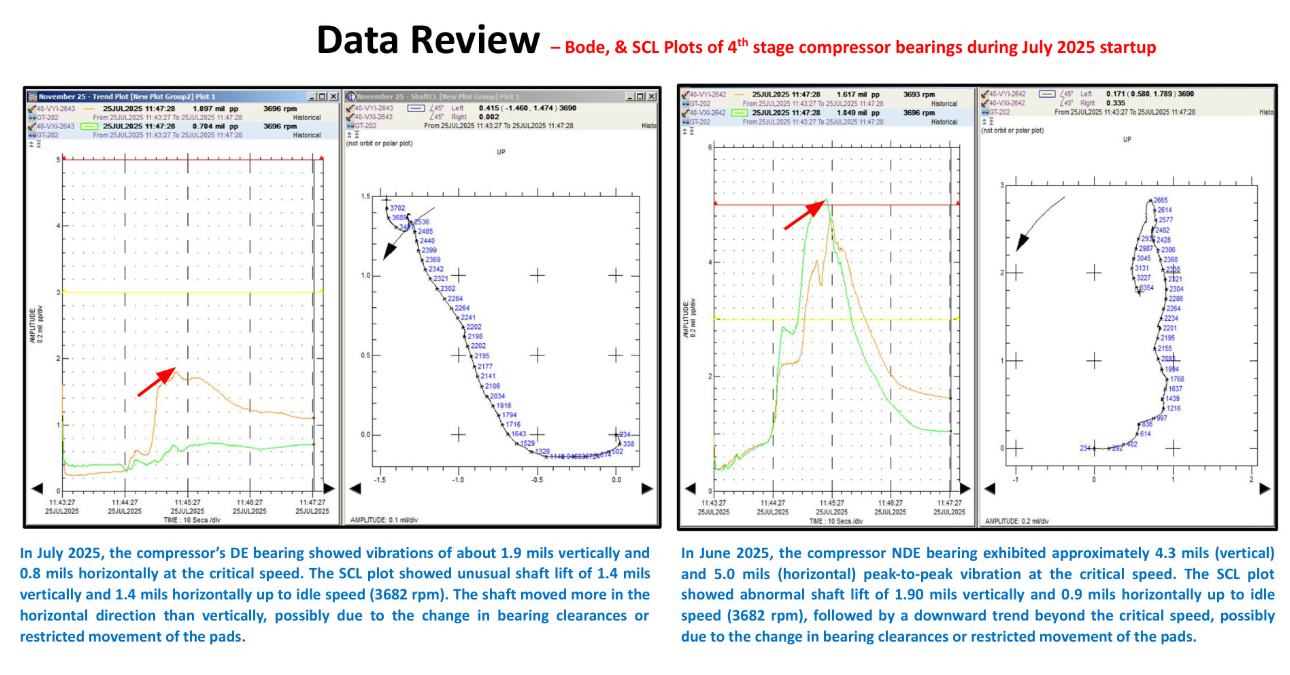
July 2025: DE bearing stabilising. DE bearing (left pair): critical speed vibration reducing to 1.9 mils vertical, 0.8 mils horizontal; SCL lift 1.4 mils vertically and 1.4 mils horizontally. NDE bearing (right pair): still elevated at 4.3 mils vertical, 5.0 mils horizontal. After full-speed operation, DE bearing stabilises at 1.60/1.17 mils p-p with no phase change — confirming a bearing fluid-film property change, not a rotor mass change.
Normal vs. Abnormal: Comprehensive Bode and SCL Comparison
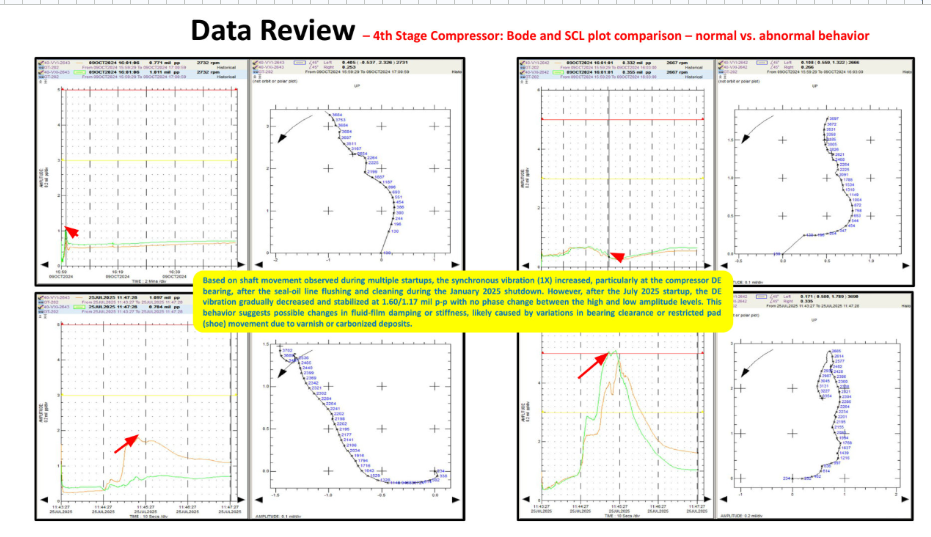
The composite comparison of the October 2024 normal baseline against the progressive abnormal startups provides the clearest diagnostic summary. The synchronous vibration increase — particularly at the compressor DE bearing — is directly correlated with the January 2025 seal-oil line flushing. The gradual self-correction behaviour following July 2025, with no phase change, is consistent with soft varnish deposits partially re-dissolving into the oil stream over time, while harder carbonized deposits on bearing surfaces and pivot points remained — as confirmed by the January 2026 inspection.
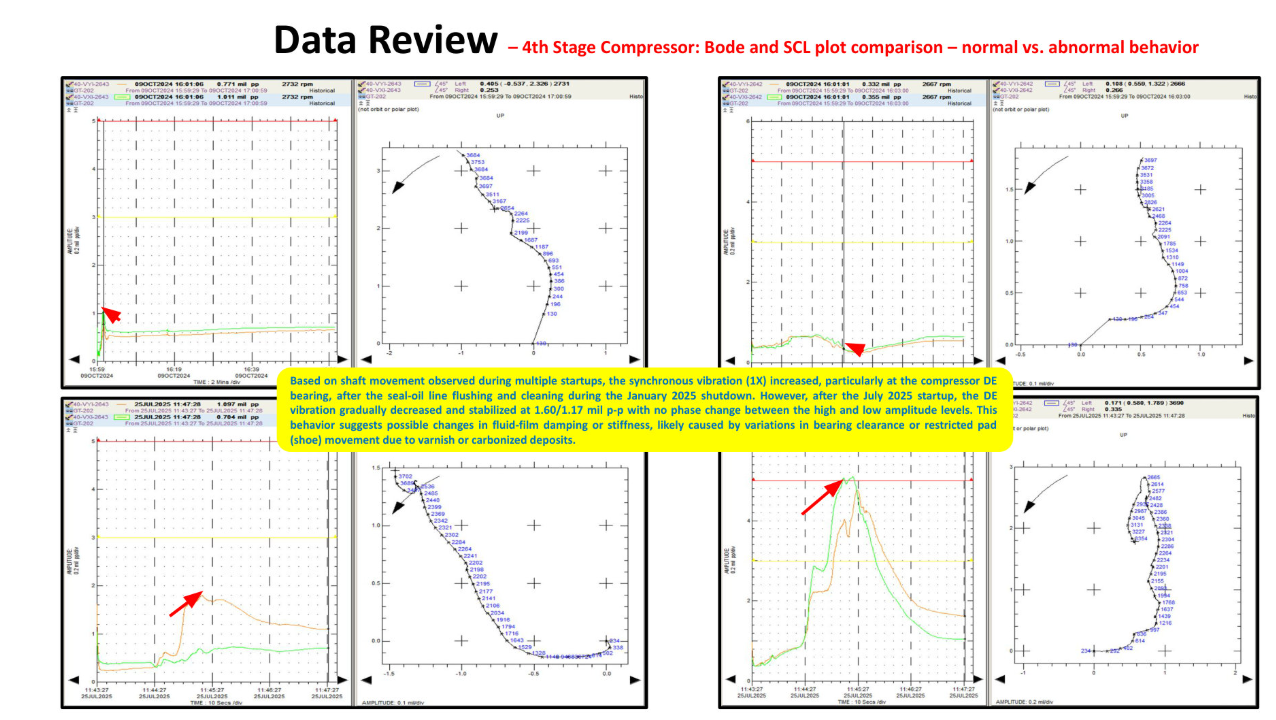
Normal vs. abnormal: comparative Bode and SCL analysis. Top row (October 2024 normal): DE bearing (left) and NDE bearing (right) showing clean Bode plots and normal SCL lift curves. Bottom row (July 2025 abnormal): DE bearing (left) showing changed SCL lift direction; NDE bearing (right) showing elevated vibration at critical speed and abnormal SCL. The progressive difference built across six startups is the diagnostic fingerprint of tilt-pad bearing varnish effects.
| Startup | DE Critical-Speed Vibration | DE SCL Lift | NDE Critical-Speed Vibration | Observation |
| May 2025 | 2.8 mils V / 1.8 mils H | 1.3 V / 1.7 H mils | 4.0 V / 4.9 H mils p-p | Unusual shaft movement |
| June 2025 | 2.0 mils V / 1.0 mils H | 1.7 V / 1.5 H mils | 4.3 V / 5.0 H mils p-p | Abnormal lift; downward trend beyond critical speed |
| July 2025 | 1.9 mils V / 0.8 mils H | 1.4 V / 1.4 H mils | 4.3 V / 5.0 H mils p-p* | DE vibration decreased |
Diagnostic Interpretation
The synchronous (1X) vibration increased, particularly at the compressor DE bearing, after seal-oil line flushing and cleaning during the January 2025 shutdown. After the July 2025 startup, the DE vibration decreased and stabilized at 1.60/1.17 mils p-p without a phase change between the high- and low-amplitude conditions.
According to the case study, this behavior suggested changes in fluid-film damping or stiffness, likely associated with variations in bearing clearance or restricted pad (shoe) movement due to varnish or carbonized deposits.
Oil Analysis and Varnish Assessment
- An oil analysis report dated 14 November 2024 indicated high MPC values and high particle count.
- Installation of a suitable online soluble varnish removal unit was recommended.
- After installation of the varnish removal unit, the MPC value decreased and returned within allowable limits.
- The system mainly removes soluble varnish precursors and fine suspended contaminants from the oil, reducing the potential for further varnish formation.
- The case study notes that such a system may not completely remove varnish already adhered to metal surfaces or carbonized deposits formed through prolonged oxidation and high operating temperatures.
Inspection and Findings
|
Date Reported |
MPC ΔE Value | Status |
Action / Note |
|
August 2024 |
36 | High | Monitoring initiated |
| September 2024 | 50 | Very high — peak |
Varnish removal unit recommended |
|
November 2024 |
32.3 | High | Unit installation initiated; bearing inspection at next shutdown recommended |
| December 2024 | 12.2 | Acceptable | Varnish removal unit operating; oil-side varnish reducing |
| February 2025 | 10.4 | Acceptable |
Oil controlled — but vibration step change already occurred post-shutdown |
|
June 2025 |
13.8 | Acceptable | Oil-side varnish controlled throughout elevated vibration period |
| September 2025 | 6.1 | Acceptable |
Oil fully controlled; bearing surface deposits confirmed at Jan 2026 inspection |
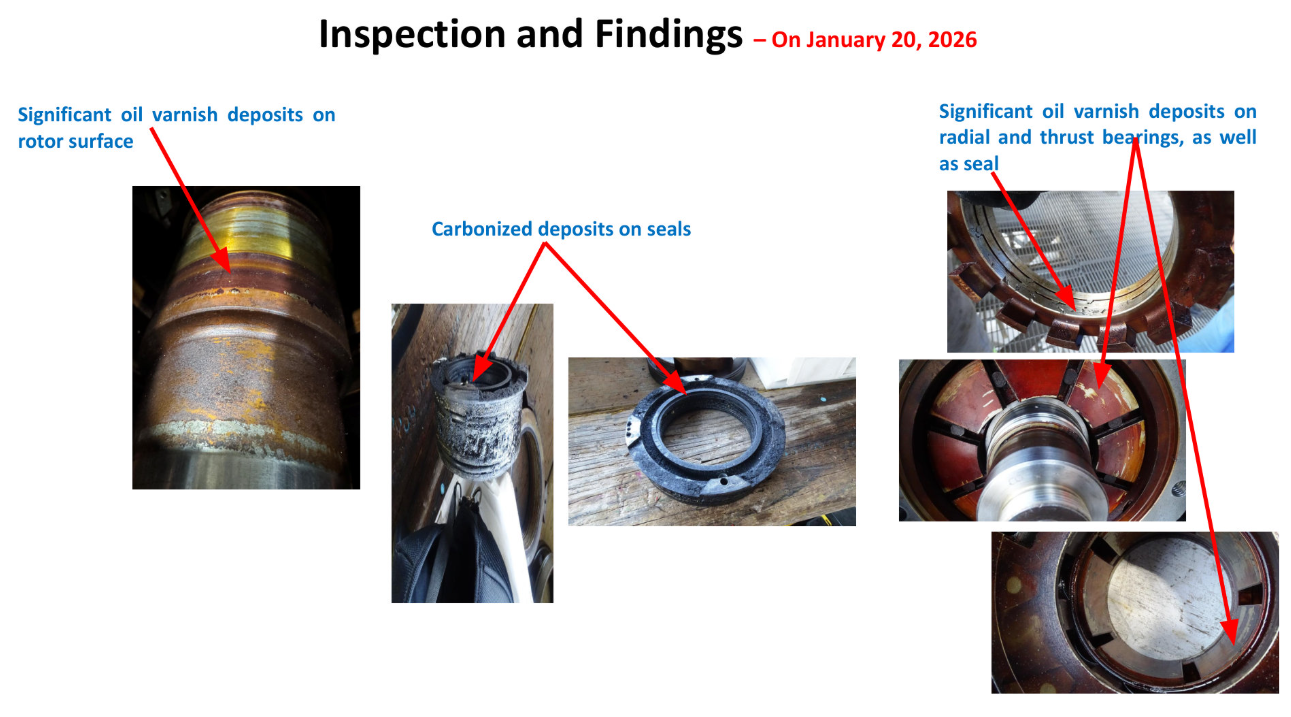
On 20 January 2026, the 4th-stage compressor was inspected. The inspection identified:
- Significant oil varnish deposits on the rotor surface.
- Significant oil varnish deposits on the radial and thrust bearings and seals.
- Carbonized deposits on the seals.
- Signs of rubbing on the bearing pads.
These findings provided physical evidence consistent with the earlier condition-monitoring observations concerning possible bearing-clearance changes and restricted pad movement.
Corrective Action and Resolution
- The 4th-stage compressor was inspected in January 2026.
- The radial and thrust bearings were replaced.
- The seals and compressor rotor were replaced.
- Following the intervention, the compressor was reported to be running with acceptable vibration levels.
Lessons Learned
The case highlights the relationship between lubricant degradation, varnish/carbonized deposits, bearing condition, shaft centerline behavior and synchronous vibration in rotating machinery.
- Lubricant degradation can result in varnish and sludge formation.
- Some deposits may thermally cure into a hard, enamel-like coating commonly referred to as varnish.
- Deposits in cooler areas may remain soft, gummy or grease-like and are generally classified as sludge.
- Varnish deposits on bearing surfaces can be associated with changes in bearing clearance and fluid-film characteristics.
- Abnormal shaft lift in shaft centerline plots, particularly in tilt-pad bearings, can provide an important diagnostic indicator.
- Monitoring trend, Bode and SCL plots across repeated startups can help identify changes that may not be evident from full-speed vibration alone.
Recommendations
- During the next maintenance shutdown, inspect the 4th-stage compressor radial and thrust bearings and seals.
- Check for carbonized deposits, varnish buildup, pad wear and pivot condition.
- Clean or replace affected components based on inspection findings.
- Continue monitoring vibration trends, Bode plots and shaft centerline behavior during startups and operating conditions.
- Continue attention to oil condition, including varnish-related indicators and particle count.
Conclusions and Recommendations
The case involved a sudden change in compressor DE bearing vibration after a shutdown involving seal-oil line flushing and cleaning. Condition-monitoring data showed increased synchronous vibration, abnormal shaft centerline movement and changed critical-speed behavior. Subsequent physical inspection in January 2026 found significant varnish and carbonized deposits on critical compressor components, together with rubbing indications on bearing pads. Replacement of the affected bearings, seals and rotor restored the compressor to acceptable vibration levels.
Conclusions and oil analysis data. MPC varnish index trend showing peak values of 50 ΔE (September 2024) and 32.3 ΔE (November 2024), reducing to acceptable levels after varnish removal unit installation. The key finding: despite oil-side cleanup, bearing surface deposits required physical inspection and component replacement to resolve.
Based on the multi-startup vibration analysis and corroborating oil analysis data, Technomax concluded that the 4th-stage compressor bearings, seals, and rotor should be inspected for carbonized deposits, varnish buildup, pad wear, and pivot condition during the next planned maintenance shutdown. The inspection was carried out on 20 January 2026.
Inspection Findings — January 20, 2026
Inspection findings, January 20, 2026. Left: Significant oil varnish deposits on rotor surface — brown lacquer-like coating on shaft journal areas in contact with bearing pads. Centre: Carbonized deposits on seals — hard, black deposits formed by prolonged thermal oxidation; insoluble in oil and unaffected by oil-side treatment. Right: Significant oil varnish deposits on radial and thrust bearings — varnish on tilt-pad surfaces and pivot points restricted pad self-alignment and altered bearing clearance, directly producing the abnormal SCL lift profiles observed across all abnormal startups.
Frequently Asked Questions
-
What is oil varnish and how does it affect compressor bearings?
Oil varnish is a degradation product of lubricating oil that deposits on metal surfaces — bearing pads, seals, and rotor journals — when oil oxidises and polymerises under heat and pressure. On tilt-pad bearing surfaces, varnish reduces effective clearance and restricts the self-aligning movement of the pads, altering the fluid-film stiffness and damping that control shaft vibration. Effects range from increased synchronous 1X vibration to intermittent spikes and, in severe cases, bearing seizure.
2. What is a shaft centreline plot and what does abnormal behaviour indicate?
A shaft centreline plot tracks the position of the rotor shaft centre — measured by proximity probes — as the machine accelerates from rest to operating speed. In a healthy fluid-film bearing, the shaft lifts smoothly as oil pressure builds. Abnormal behaviour — altered lift magnitude, horizontal-dominant movement instead of vertical, or a downward trend after critical speed — indicates changes in bearing clearance, oil film properties, or pad movement capability. SCL plots are the most sensitive vibration-based indicator of tilt-pad bearing varnish effects.
3. What is the MPC test (ASTM D7843) and what do the values mean?
The Membrane Patch Colorimetry test measures varnish-forming contaminants in a lubricating oil sample, expressed as a ΔE colour value. Values below 15 are acceptable. Values between 15 and 25 indicate elevated varnish potential. Values above 25 indicate high varnish potential and should trigger both oil-side varnish control measures and bearing inspection at the next available shutdown opportunity.
4. Can an online varnish removal unit resolve bearing varnish problems?
An online varnish removal unit removes soluble varnish precursors from the circulating oil — reducing future formation potential. It cannot remove varnish already adhered to and cured on bearing surfaces or the carbonized deposits formed by prolonged thermal oxidation. These require mechanical cleaning or component replacement during a planned shutdown. The oil MPC returning to normal does not confirm bearing surfaces are clean.
5. How does Technomax diagnose varnish-related bearing faults?
Technomax uses a multi-parameter approach: trend analysis of 1X vibration at full speed and critical speed across multiple startups; Bode plot comparison between startups; shaft centreline plot analysis for bearing clearance and pad behaviour changes; and parallel oil analysis using MPC ASTM D7843. In complex progressive cases, the diagnostic conclusion is built from the correlation between all data sources over an extended monitoring period — not from a single measurement snapshot.

Recent Case Studies


Get Started Now!
It takes less than a minute of your time. Or you may simply call +971 2 555 1 783