


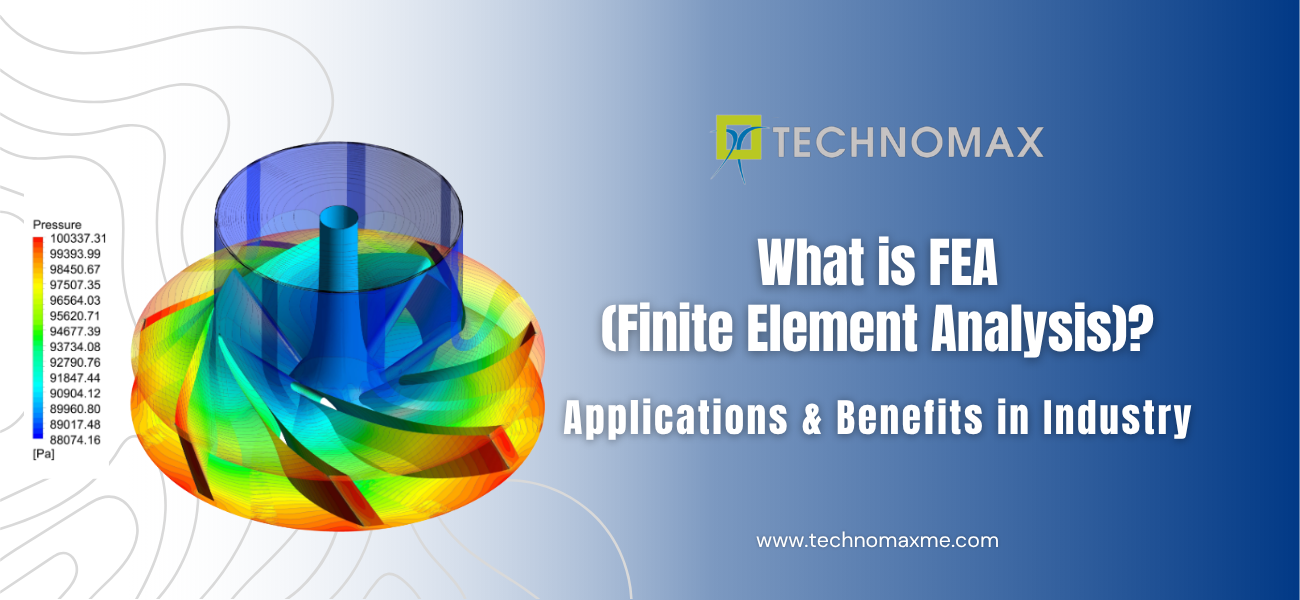
Finite Element Analysis (FEA) is a numerical technique that is used to tackle complex engineering challenges. Finite Element Analysis has become an imperative tool across modern engineering industries, helping them determine product behaviour, paving the way to minimise risks and to improve overall product quality before the real manufacturing actually commences. Achieving reliability, safety and superior performance is the primary goal as it has become a necessity, not just an advantage.
By using advanced simulations and computational techniques, engineers can evaluate how components and structures react under certain real-world situations without actually depending on prototypes or performing trial-and-error methods. So, these simulations and computational techniques not just save time, but also reduce expenses and push the overall development process.
Over the years, the FEA’s impact on industries has been remarkable, enabling engineers to identify weaknesses in designs at an early stage. FEA can create simulations of practical operating environments supporting proper material selection, optimising design efficiency and improving structural integrity, all of which help industries achieve safer, more durable and high-performance solutions.
Finite Element Analysis(FEA): Understanding the Basics
Finite Element Analysis (FEA) in today's industries is a way to improve product quality, enhance safety, and efficiency in operations before even the actual production starts. When products are regarded for durability, cost-effectiveness, reliability and efficiency, businesses achieve these parameters by adopting precision strategies such as FEA, allowing them to test and evaluate the designs virtually instead of depending on cumbersome processes like repeated testing and creating physical prototypes.
FEA works by dividing a large structure into many tiny sections or elements. These elements are connected to form a mesh that represents the entire structure. Engineers then set loads, pressure, temperature, and other operating conditions to understand how the structure behaves in real-world settings. This process makes it possible to identify stress, deformation, heat distribution, or weak points before the product is manufactured.
One of the great advantages of FEA is its ability to analyse complex, intricate shapes and operating conditions that are difficult to study using traditional calculations. It helps engineers improve designs, reduce material waste, lower developmental costs and improve overall product reliability. Industries like Oil&Gas, Aerospace, Automotive, Manufacturing and construction widely apply FEA for precision analysis of pipelines, bridges, aircraft parts, machinery, and industrial equipment.
How FEA Works?
FEA is based on mathematical equations that describe the physical behaviour, such as stress, strain, heat channelling, vibration, and more. FEA meticulously solves complex mathematical equations, which eventually explain the physical behaviour of a component or a structure, for instance, the idea of stress-strain relationships, heat transfer, deformation, weak spots and more.
The test structure is broken down into smaller finite elements, each assigned equations that link forces to displacements. These individual equations are then compiled into a complete system that shows the whole model. By giving boundary conditions and loads, this system of equations is solved to reveal unknown characteristics such as displacement, temperature, or pressure.
The mathematical equations are derived from fundamental principles like equilibrium, material constitutive laws and compatibility. The software simplifies these equations for each element and integrates the results to reveal the overall behaviour of the structure. Advanced FEA software performs these automated calculations more easily, allowing engineers to focus on core elements like improving the design and interpreting the results more accurately.
What Is the FEA Process and How Does It Work?
The FEA process usually consists of three main stages that must be executed carefully. The following are the general steps involved:
- Pre-Processing
This stage is where the geometry creation, material properties setting, mesh generation, and application of loads and boundary conditions take place. Proper model setup is important because inaccurate inputs can affect the precision of the further stages and even the final results.
Engineers define boundary conditions during this stage, such as loads, forces, temperatures, pressures, constraints and more. These act and represent the actual operating surroundings, since a proper setup is a vital element, as incorrect input can create inaccurate simulation outputs.
2. Processing
This stage is where the actual process takes place; the software performs the simulation process and solves the mathematical equations. Depending on the complexity of the model, this process can take a few minutes or several hours.
During this stage, the software calculates important parameters such as:
- Stress distribution
- Strain
- Displacement
- Temperature fluctuation
- Vibration response
- Pressure distribution
- Fatigue behaviour
Advanced FEA software can also handle complex non-linear problems involving large deformations, material plasticity, contact interactions, and dynamic loading conditions.
3. Post-Processing
This is the final stage that involves carefully studying and interpreting the simulation results. Skilled engineers analyse stress patterns, deformation, temperature distribution, and other important parameters using graphical visualisation tools.
FEM vs FEA: Understanding the Difference
The Finite Element Method (FEM) and Finite Element Analysis (FEA) are related concepts in engineering but have different roles. FEM is the mathematical framework that underpins and strengthens the analysis, while FEA is the practical application that engineers use to simulate and study how structures behave in the real world. In simpler terms, FEM provides the theory, and FEA uses that theory to analyze structures.
What is FEM (Finite Element Method)?
The Finite Element Method or FEM is a mathematical technique for solving complex and intricate engineering problems. It works by breaking large structures into smaller sections or finite elements, which are connected through nodes forming a mesh.
Mathematical equations are assigned to every single element to calculate the structure's behaviour under dynamic conditions such as:
- Stress and strain
- Heat transfer
- Vibration
- Fluid flow
- Dynamic loading
In a nutshell, FEM is the theoretical framework that engineers use to analyze complex geometries and conditions that otherwise cannot be solved using traditional methods.
What is FEA (Finite Element Analysis)?
Finite Element Analysis (FEA) is the technique that applies the FEM principle using advanced computer simulation software. It is a comprehensive engineering analysis method used to study the behaviour and performance of components and structures under real-world dynamic settings.
In an FEA simulation, generally, engineers can perform the following :
- Create a 3D model of the component under analysis
- Define material properties like elasticity, density, and thermal characteristics
- Generate the FEM mesh
- Apply loads, pressures, temperatures, or boundary conditions
- Run simulations using FEM equations
The software then gives graphical visuals and numerical results of;
- Stress distribution
- Deformation and displacement
- Thermal response
- Fatigue life
- Safety factors
- Failure prediction
These in-depth analyses help engineers optimise designs, improve dependability, minimise material wastage, and detect potential failures before actual production begins.
Important difference between FEM and FEA
| FEM | FEA |
| Numerical and methodical steps | Practical simulation process |
| Creates the theoretical base | Applies FEM principles via advanced software |
| Solves equations for individual elements | Analyses the whole structure and products |
| Focuses on fundamental calculations | Focuses on actual performance evaluation |
Benefits of FEA Analysis for structural performance and reliability
FEA is crucial for enhancing component and structural performance as well as reliability
The following are some of the advantages of adopting FEA techniques:
- Design Efficiency: FEA enables engineers to evaluate multiple design concepts without developing expensive physical prototypes. This accelerates the design process and helps identify the most effective solution under different operating conditions.
- Cost Effectiveness: FEA minimizes the need for repeated physical testing and prototype development, resulting in lower development costs, reduced material waste, and fewer design-related failures.
- Product Optimization: FEA provides detailed insights into how components and structures respond to stress, vibration, heat, and other conditions, helping engineers improve product strength, durability, reliability, and performance.
- Improved Safety: FEA helps detect weak points and potential failure areas before actual operation, ensuring structures can safely withstand loads while meeting industry safety and compliance standards.
Types of FEA: Understanding the Various Methods of Finite Element Analysis (FEA)
Several factors need to be taken into account when choosing the right tools for different engineering challenges. The following are some of the most common types of FEA:
Structural Analysis: it determines how a structure behaves under forces, pressure and different loads. It helps evaluate stress, fatigue or deformation, making sure the design can really withstand operational challenges without failure.
Thermal Analysis: Thermal Analysis provides a detailed insight into the heat transfer and temperature distribution within a system. It is critical for components exposed to a high-temperature environment to ensure proper heat management and prevent overheating.
Vibration Analysis: Vibration Analysis checks how structures and components react to different loads and oscillations. It identifies natural frequencies and avoids resonance issues, which can lead to structural failure.
Fluid Dynamics Analysis: Fluid Dynamics Analysis, or commonly called Computational Fluid Dynamics (CFD), studies fluid dynamics and evaluates how fluids may interact with surfaces. It is beneficial to analyse airflow, pressure distribution, and fluid behaviour, thereby improving efficiency and performance in pipelines, aero-dynamic and structures.
FEA or CFD: Which is Better?
Finite Element Analysis (FEA) and Computational Fluid Dynamics (CFD) are both essential analytical simulation tools, yet they serve different analyses. FEA is mainly used to estimate the structural behaviour of components, such as stress, fatigue, deformation, vibration and thermal variations under different conditions. While CFD analyses the fluid flow, heat transfer, pressure distribution, turbulence and airflow or liquid movement within objects.
| Finite Element Analysis (FEA) | Computational Fluid Dynamics (CFD) | |
| analysis | Analyses structural and mechanical behaviour | Analyses fluid flow and thermal behaviour |
| Used for | Stress, strain, deformation, vibration, fatigue | Airflow, liquid flow, turbulence, and pressure distribution |
| Principle | Finite Element Method (FEM) | Fluid dynamics and Navier–Stokes equations |
| Used For | Solid structures and components | Fluids and gas movement analysis |
| Suitable for | Best for structural analysis | Best for fluid and flow analysis |
Applications of FEA in Industries
Finite Element Analysis (FEA) is used in many practical areas, helping provide accurate and detailed insights into designing bridges, analysing aircraft parts, testing pressure valves and more. The following are some of the mainstream industries that use FEA for strategic development:
- Manufacturing and Heavy Engineering Industries: FEA is used to design machinery, tools, and equipment. Finite Element Analysis provides detailed insights to optimise material usage and distribution, improve product performance and durability, ensuring efficient operations.
- Oil and Gas: FEA is vital in the energy and utility industries as it is useful for evaluating pipelines, pressure vessels, onshore and offshore structures. FEA ensures precision, safety and reliability in vivid and challenging environments, reducing the risk of breakdowns or leakage.
- Automotive and Aerospace Sectors: In the automotive and aerospace industries, FEA has become an essential element, it is used to design feasible and efficient systems. FEA evaluates fuel efficiency, performance, and safety; it also ensures regulatory standards.
Why Choose Technomax for FEA services in the UAE ?
Technomax Middle East Engineering is the pioneer of condition monitoring and asset reliability solutions, offering advanced analytical tools, decades of experience, expertise and efficient workflows. Technomax ensures improved design quality, reducing material wastage and lowering development costs, which are pivotal for achieving all-around efficiency and optimization.
At Technomax, FEA analysis and various other asset condition monitoring services are performed by expert and skilled engineers, making sure the industries receive expert-driven analysis, improved precision and reliability. Experienced and seasoned consultants bring knowledge as well as technical expertise, as accuracy is supreme in these sectors. Our team identifies issues, optimises designs and provides actionable insights to improve the overall efficiency and performance.
Ensure design optimisation with expert and certified FEA Analysis in UAE- Partner with Technomax to upscale your efficiency.
FAQs
1- What do you mean by FEA analysis?
FEA (Finite Element Analysis) is a methodological simulation technique used to determine how a structure or component behaves under forces, heat, or other conditions. It breaks complex models into smaller elements(mesh) to analyse stress, strain, and deformation.
2- Can ChatGPT do finite element analysis?
ChatGPT cannot actually perform FEA simulations or replace engineering software. But it can help clarify concepts, guide setup steps, and support in the analysis and interpretation of results.
3- What's the difference between CFD and FEA?
FEA focuses on solid structures and their response to loads, while CFD (Computational Fluid Dynamics) analyses fluid flow, pressure, and heat transfer in liquids and gases.

Recent Blogs

Get Started Now!
It takes less than a minute of your time. Or you may simply call +971 2 555 1 783